
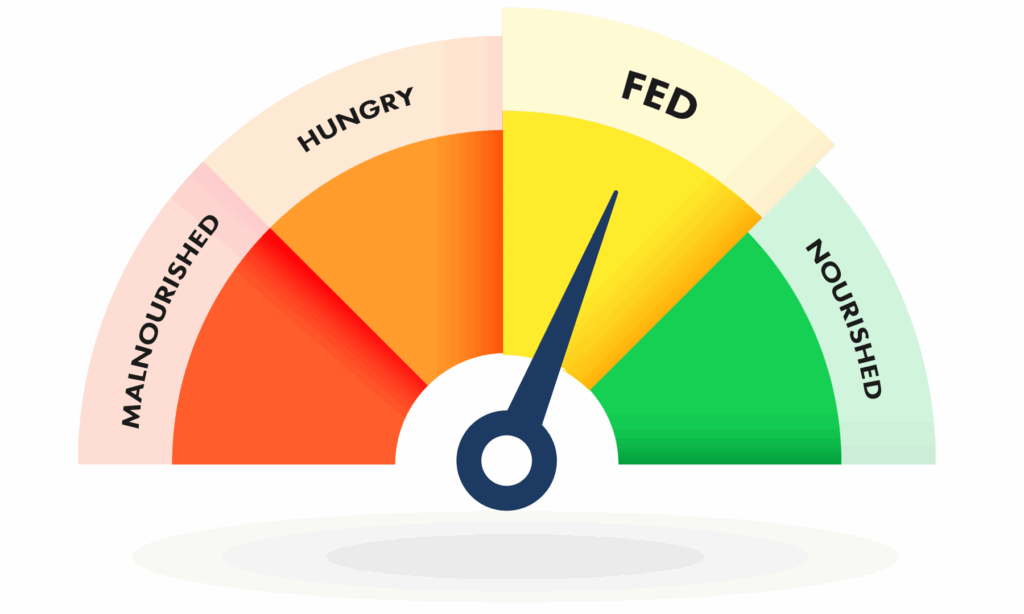
OVERALL SCORE
46/75



Below you'll find the questions and your answers grouped by section. If you scored 3 or lower, we've provided an action step. 4 and higher—no action needed. Keep up the great work!
Strengthen scope & sequence: Map your teaching plan so kids see the big story of Scripture, not just random lessons. (See Chapter 8 of Feeding Faith.)
Pick one abstract truth in your upcoming lesson and turn it into something kids can see or touch—use a simple prop, image, or object that visually represents the key idea and hold it up as you teach. (See Chapter 10 of Feeding Faith.)
Evaluate your last few lessons and adjust the next one in the direction you’re deficient—either clearer teaching or deeper response. Consider a curriculum with better balance. (See Chapter 12 of Feeding Faith.)
Encourage leaders to share one real-life example each week of how they’re living out the Big Idea so kids can imitate what they see. (See Chapter 12 of Feeding Faith.)
End each lesson with one specific, real-life action that kids can take this week. Not a general principle like “be kind,” but something concrete like “invite someone to sit with you at lunch.” (See Chapter 12 of Feeding Faith.)
Invite your leaders to identify one struggling child or family and take a simple step of relational support this month. Encourage them to share these stories with one another to normalize compassion within your team. (See Chapter 13 of Feeding Faith.)
Add a simple gospel connection to each lesson so kids see how every story fits into God’s plan to rescue and redeem through Jesus. (See Chapter 16 of Feeding Faith.)
Write out a simple, age-appropriate explanation of what it means to follow Jesus (1–3 sentences) and keep it printed inside your Bible. Share it at least once a month during large group. (See Chapter 16 of Feeding Faith.)
At regular intervals, give kids clear, age-appropriate opportunities to begin a relationship with Jesus—and pray with those who are ready to take that step. (See Chapter 16 of Feeding Faith.)
Build in a Response Time—moments of prayer, journaling, artistic expression, or Bible reading—so kids have space to respond personally to what God is doing in their hearts. (See Chapter 17 of Feeding Faith.)
Choose one identity truth (loved, forgiven, child of God, never alone, etc.) and speak it aloud over the group every week—use the same phrase for a full month. (See Chapter 18 of Feeding Faith.)